
Northern Shenandoah Valley trees
Dying Oaks and Ash in Front Royal, VA
Short answer
Oaks around Front Royal are dying after repeated spongy moth defoliation and drought: a September 2024 aerial survey mapped more than 10,000 acres of oak decline or mortality in the northern Shenandoah Valley (Virginia Forest Health Highlights 2024, checked Nov 22, 2026). Ash are being killed by the emerald ash borer, which Rappahannock Electric Cooperative first found killing ash along its lines in 2014 (REC, checked Nov 22, 2026).
A dead or dying tree within reach of a house, a drive or a line is a removal job, and the sooner the better: dead ash turn brittle fast. One independent local contractor who works Front Royal and Warren County can look at yours and price it.
What happened to the oaks?
Spongy moth caterpillars eat oak leaves in late spring, and in bad years they strip whole ridgesides. The state's yearly forest health reports track it:
- 2023. An aerial survey "mapped over 37,000 acres with defoliation within Shenandoah National Park," along the Massanutten range and along the Virginia-West Virginia line, all counted together. Many western Virginia counties were abnormally dry to severely dry that summer and fall (Forest Health Highlights 2023).
- 2024. Surveys mapped 57,591 acres of heavy and 27,525 acres of moderate defoliation in the Shenandoah Valley and the mountains west of Harrisonburg and Charlottesville, many areas in their second or third year. A September survey found more than 10,000 acres of oak decline or mortality in the northern Shenandoah Valley, most likely from the moth, and the report warned that drought on top of defoliation may leave long-term damage in northern Shenandoah forests (Forest Health Highlights 2024).
Both checked Nov 22, 2026. Skyline Drive's mileposts start at 0 in Front Royal (NPS), so the park in these reports is the one on the town's doorstep. Samples from declining oaks in two Valley counties also tested positive for Diplodia, which the 2023 report calls an opportunistic pathogen.
How can you tell if a yard oak is dying?
These are the things to look for and mention when you call:
- A crown that stays thin or bare into July, or leafs out only on the lower half.
- Whole branches, not just twigs, with no leaves at all.
- Bark loosening or falling away in sheets on the trunk or big limbs.
- Mushrooms or shelf fungus at the base or on the trunk.
- Fresh woodpecker work and sawdust in bark cracks.
- Bare limbs over the house that weren't bare last year.
One bad year doesn't always kill an oak. Two or three in a row, with drought, is when the 2024 report started counting dead ones by the thousand acres. A contractor on site can tell you whether the crown has enough live wood left to keep.
What is the emerald ash borer doing to ash?
The Virginia Department of Forestry calls the borer "a beetle from Asia that feeds on the tissue under the bark of ash trees," and says it has "killed hundreds of millions of ash trees" (VDOF, checked Nov 22, 2026). Virginia's first established population was found in 2008, and by 2024 the borer was confirmed in 86 Virginia counties (VCE 2904-1290; Forest Health Highlights 2024, checked Nov 22, 2026).
Virginia Cooperative Extension lists the signs (VCE, Jan. 9, 2024, checked Nov 22, 2026):
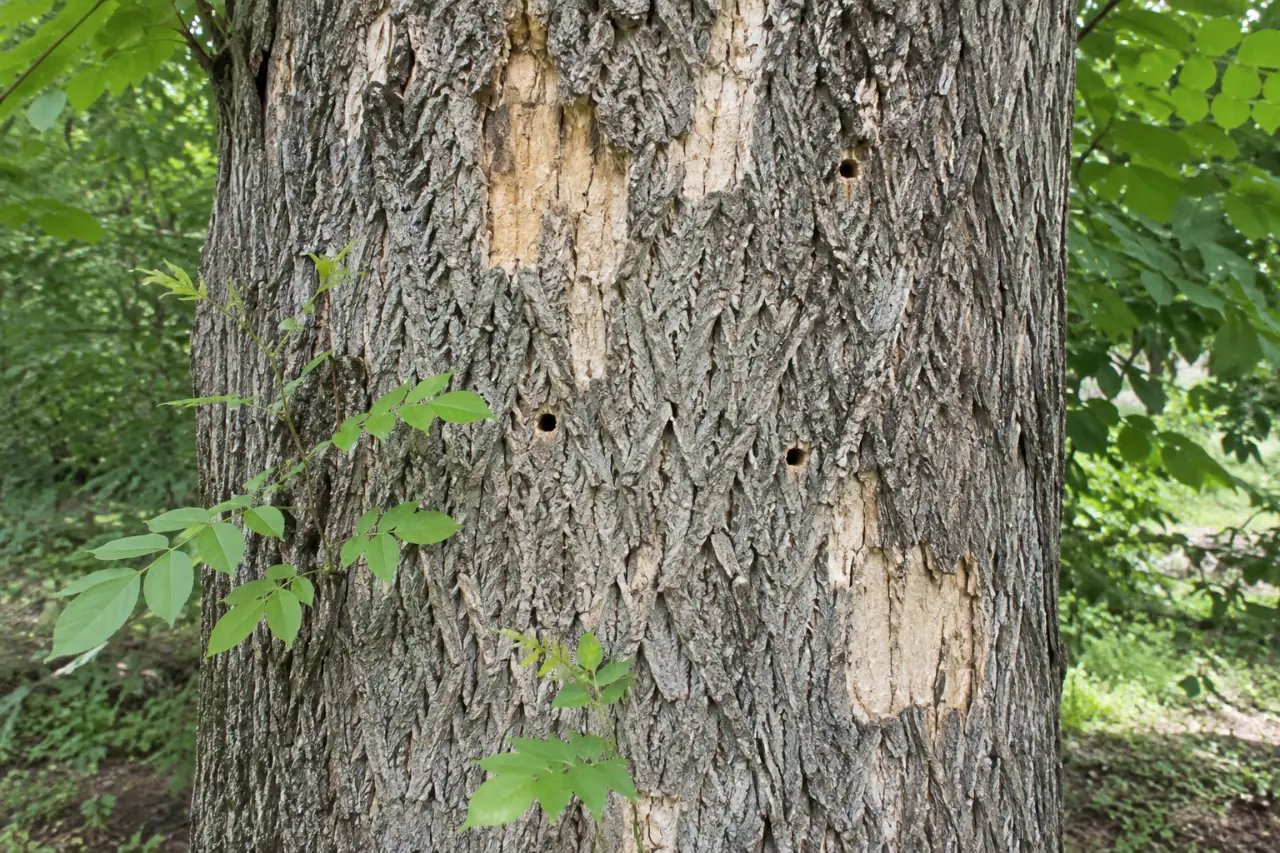
- D-shaped exit holes about a quarter inch across in the bark.
- S-shaped tunnels under loose bark near the holes.
- Pale patches high in the tree where woodpeckers have stripped the outer bark to reach the larvae, called "blonding."
- A thinning upper crown, and new shoots sprouting from the trunk.
Extension says noticeable damage usually takes 2 to 5 years to show, and the tree typically dies soon after.
Treat the tree or take it down?
Ash not yet infested: Extension says a healthy ash can be protected with a systemic insecticide applied as a soil drench at the base of the tree in May or early June, before it's attacked. The Department of Forestry runs an Emerald Ash Borer Treatment Cost-Share Program that "provides assistance for treating individual ash trees," with its own application form (VDOF, checked Nov 22, 2026).
Ash already infested: Extension's advice is blunt: infested trees rarely recover and should be "removed and destroyed or chipped as soon as possible" (VCE, checked Nov 22, 2026).
Oaks: there's no spray that brings back a crown that has died. The choice is whether enough of the tree is alive to keep, with the dead wood pruned out, or whether it should come down before it drops limbs.
Why does waiting cost more?
Because dead wood gets weaker every month. REC says ash killed by the borer "quickly become brittle and can fail without warning," and that its crews find them hazardous to climb (REC, checked Nov 22, 2026). A tree a climber can still go up is usually the cheapest version of the job. Once it's too brittle to climb, the work moves to a lift or a crane, and HomeGuide's national figure for a dead tree is already $800 to $1,600 before any crane time (HomeGuide, checked Nov 22, 2026). The removal page explains the methods.
What else is showing up nearby?
Beech leaf disease was first confirmed in Virginia in 2021 in Prince William County, and Clarke County, Warren's neighbor to the northeast, was added in 2024, for six counties in all (Forest Health Highlights 2024, checked Nov 22, 2026). Warren wasn't on that list. The spotted lanternfly, which reached Warren County by 2021, feeds on tree of heaven, maples and other trees; the tree of heaven page covers it.
Die-off questions
Can I burn or give away the ash wood?
Keep ash wood on your own property. REC asks members not to move it, to slow the borer's spread (REC, checked Nov 22, 2026). Burning it on the property keeps it from moving, but open burning is banned outright in the High Knob and Blue Mountain subdivisions (Warren County Code Chapter 92).
The dead ash is near the power line. Who takes it down?
Call REC at 800-552-3904 if it's near their overhead lines; they ask members to call for an arborist assessment. For a Town line, call Energy Services at (540) 635-3027. See trees and power lines.
Will a defoliated oak leaf out again?
Some do. Whether the tree survives depends on how many years in a row it's been hit and how dry the summers were, which is why a second look the next spring is worth it.
A tree at your place?
One independent local contractor who works Front Royal and Warren County can come look at it and give you a price.
Call (540) 660-7988 Or describe it on the request form