
The two forks
Shenandoah River Trees in Front Royal, VA
Short answer
Trees on river lots around Front Royal live with floods: the Shenandoah at Front Royal has risen past its 12-foot flood stage 51 times since records began in 1901, with the record crest of 34.8 feet on Oct. 16, 1942 (National Weather Service flood climatology). Cutting a tree on a river lot needs no permit, but filling, grading or digging in a floodplain needs a Town zoning permit inside town limits, and land disturbance in the county's Floodway District needs a county permit (Town Code §175-79; Warren County Code §180-16K, checked Nov 22, 2026).
One independent local contractor who works Front Royal and Warren County can look at a river-lot tree, including one undercut or tipped by high water, and price the work.
How often does the river flood at Front Royal?
The Weather Service's gauge at Front Royal sets minor flooding at 12 feet, moderate at 14 and major at 18 (NWS flood categories, checked Nov 22, 2026). The five highest crests:
| Date | Crest | Flow |
|---|---|---|
| Oct. 16, 1942 | 34.8 ft | 130,000 cubic feet per second |
| Sept. 7, 1996 | 32.57 ft | 121,000 cfs |
| Nov. 6, 1985 | 32.43 ft | 120,000 cfs |
| March 18, 1936 | 26.01 ft | 98,000 cfs |
| Jan. 20, 1996 | 25.2 ft | 81,000 cfs |
Of the floods on the list, March and September turn up most often. The most recent moderate floods came on June 3, 2018 (16.52 feet) and Sept. 18, 2018 (14.34 feet).
The rest of the county's streams flood too. In the November 1985 "Election Day" flood, the North Fork near Strasburg, on the Warren County side, crested at 27.37 feet against a 17-foot flood stage, and Passage Creek near Buckton reached 10.45 feet against a 9-foot flood stage (NWS Sterling).
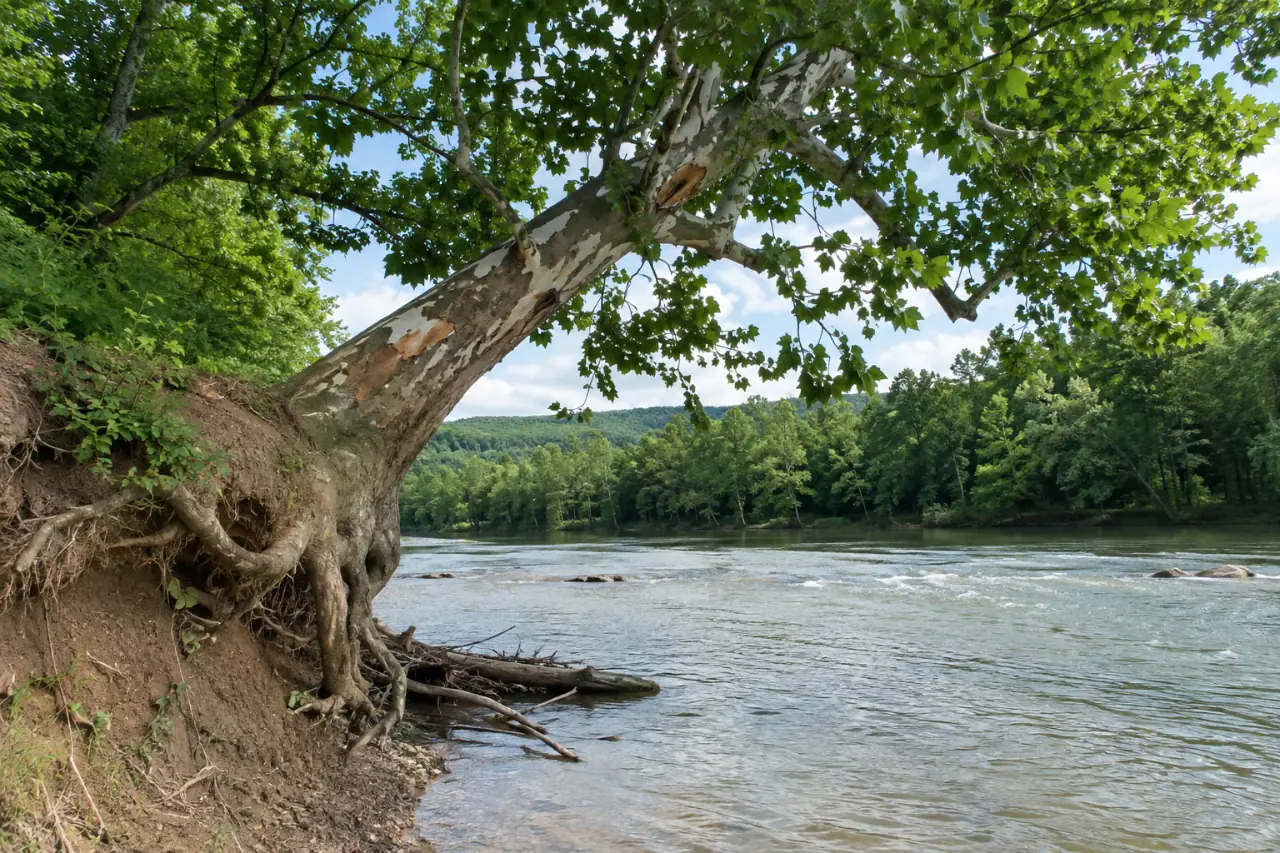
What does high water do to riverbank trees?
After a flood, walk the bank and look for:
- Trees whose roots are exposed where the bank has washed out from under them.
- A new lean toward the water, or a ridge of lifted soil on the land side of a trunk.
- Drift piled against the upstream side of trunks, adding load and trapping the next flood's debris.
- Bark scraped off low on the trunk by floating logs.
- Whole trees tipped over in the soaked ground, root plate and all.
A bank tree that has started to go toward the water often can't be felled the way it leans without putting the trunk in the river. That's a rigging job, and a reason to call before the next high water moves it for you.
Which trees grow on the river bottoms?
USDA's description of the Chagrin soil, a deep, well-drained silt loam "formed in alluvium on flood plains" and part of the Unison-Chagrin-Dyke group on Warren County's soil map, lists native hardwoods including beech, hickory, sugar maple, ash and sycamore (USDA, Chagrin; Warren County soil map, checked Nov 22, 2026). The Unison soils of the stream terraces and footslopes above them carry oaks, maple, poplar, hemlock and pine (USDA, Unison, checked Nov 22, 2026).
Ash deserves a closer look on a river lot. It's the emerald ash borer's target, and a dead ash on a bank combines brittle wood with soft footing; see the die-off page.
Do you need a permit to work on a river lot?
To cut a tree, no. To change the ground, possibly:
- Inside town. "All uses, activities, and development occurring within any floodplain district shall be undertaken only upon the issuance of a Zoning Permit" (§175-79(A)), and development covers "Any man-made change to improved or unimproved real estate," including filling, grading, paving and excavation (§175-75(G)). In the floodway itself, "no encroachments, including fill, new construction" are allowed unless an engineer's analysis shows no rise in flood levels (§175-76(B)(1)). Altering or moving a channel also takes permits from the U.S. Army Corps of Engineers, the Virginia Department of Environmental Quality and the Virginia Marine Resources Commission (§175-80(J)).
- In the county. In the Floodway District, a floodplain determination and permit are required for any land disturbance or erosion stabilization (§180-16K(6)(a), amended May 21, 2013), and channel changes need federal and state permits too (§180-16K(2)(l)).
Sources: Town Code Chapter 175; Warren County Code Chapter 180, checked Nov 22, 2026. In practice: felling and chipping is fine; grinding a stump leaves the grindings in place; digging out a root ball and trucking in fill, or rebuilding a washed-out bank, is the point to call the Town or county first.
How does equipment get onto a river lot?
Carefully, and not right after a flood. Silt bottoms can stay soft for days after the water drops, and a loaded truck or a grinder can sink or rut the lawn. Ask the contractor what the heaviest machine on the job weighs, where it will drive, and whether mats or plywood will go down. On lots where the only way in is a low road that floods, the job may have to wait for dry ground.
River lot questions
Should the trees on my bank come out?
Usually only the ones that are dead, badly undercut or leaning over something they'd hit. Living roots hold a bank; a row of stumps doesn't hold it for long.
A neighbor's tree washed onto my lot. Can a crew cut it up?
Yes, once it's on your land and clear of any line. If it damaged a building, photograph it first and call your insurance company.
Where should the cut wood go on a river lot?
Leave cut wood and brush well above the high-water line so the next flood doesn't carry it downstream into someone else's bridge or fence.
A tree at your place?
One independent local contractor who works Front Royal and Warren County can come look at it and give you a price.
Call (540) 660-7988 Or describe it on the request form