
Northern Shenandoah Valley trees
Tree of Heaven Removal in Front Royal, VA
Short answer
Tree of heaven removal in Front Royal takes more than a saw: Virginia Cooperative Extension says cutting the tree makes it "resprout vigorously" from its roots and stump, so the cutting has to be paired with an herbicide, and triclopyr is the one it lists as proven (VCE 420-322, revised Feb. 2026, checked Nov 22, 2026). It matters more here than in most places because tree of heaven is a favorite host of the spotted lanternfly, which the state records as having spread to Warren County in 2021 (Virginia Register, Feb. 27, 2023).
One independent local contractor who works Front Royal and Warren County can take down a big one near the house and talk through how the sprouts will be handled.
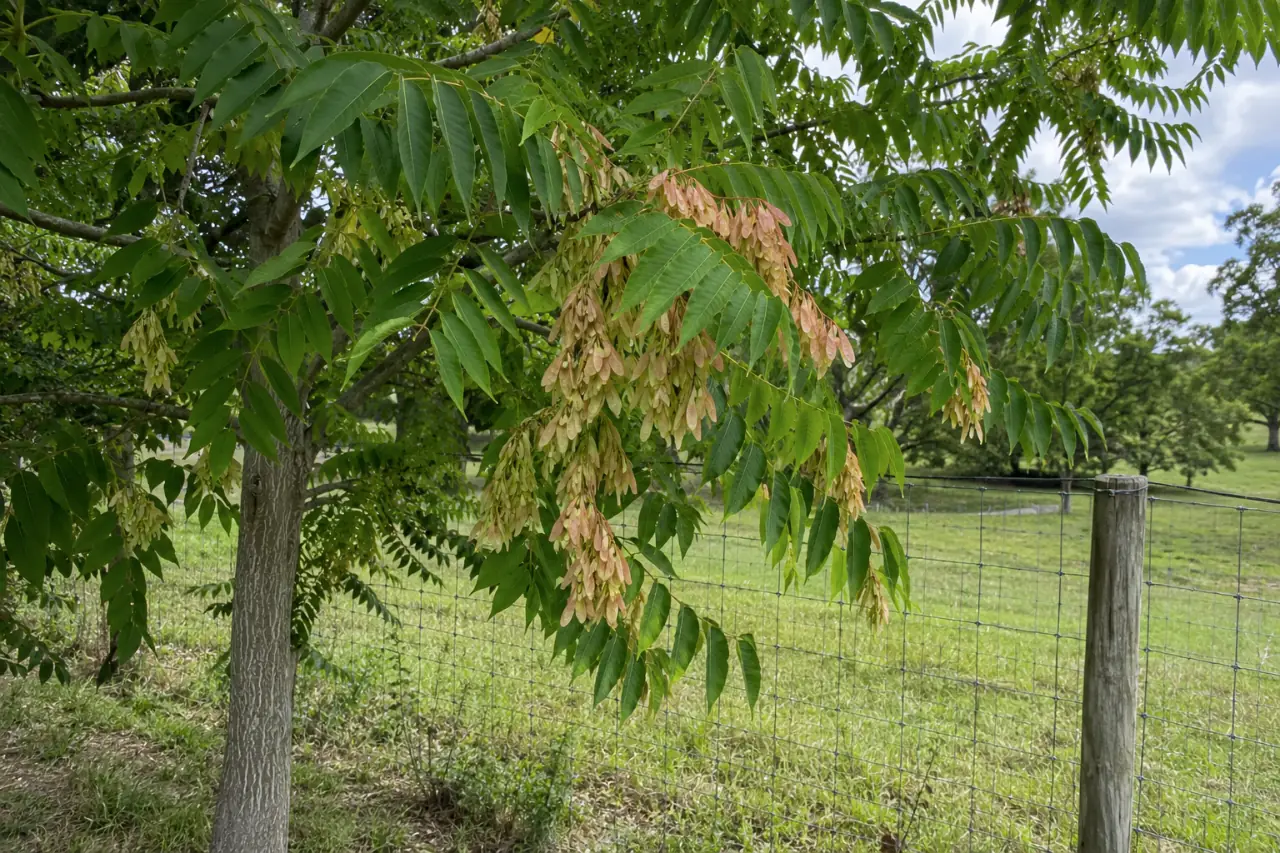
How do you recognize tree of heaven?
From Extension's description (VCE 420-322, checked Nov 22, 2026):
- Leaves one to three feet long, made of 9 to 41 leaflets along a central stem. Each leaflet usually has a pair of small glandular teeth near its base.
- The smell. Snap a twig: the inside smells like rancid or burnt peanut butter. Extension calls this the most convincing sign.
- Twigs stout, with big shield-shaped leaf scars and a light brown, spongy pith.
- Bark smooth and green when young, then brown, then gray with a pattern Extension compares to a cantaloupe.
Look-alikes. Native sumacs have small, red, fuzzy fruit that hangs on through winter. Black walnut has a chambered pith and a citrus-like scent. Tree of heaven has neither.
Why does cutting it make more?
Because the root system survives and answers. Extension says stems "can grow eight feet in one year," trees can reach 100 feet, and cut stems often come back as dense thickets of nothing but tree of heaven. Cutting has to be combined with chemical control "unless the entire root system is excavated," which usually isn't feasible (VCE, checked Nov 22, 2026).
That's why a tree of heaven taken down and ground like any other tree so often turns into a ring of sprouts around the stump, and suckers coming up in the lawn yards away.
What does Extension recommend?
Extension lists triclopyr as effective in three ways: sprayed on the leaves, applied to the bark near the base, or applied to a fresh cut stump, with a surfactant recommended for the leaf and bark methods (VCE 420-322, checked Nov 22, 2026). Any herbicide goes on by its label.
When you talk to a contractor about a tree of heaven, ask three things:
- Will the tree be treated before it's cut, or the stump right after, and with what?
- What happens to the sprouts that come up next season?
- Is grinding the stump worth it, or is it better left until the roots are dead?
What does the spotted lanternfly have to do with it?
The spotted lanternfly was first found in Virginia in 2018 (VDACS). The state's first quarantine, in 2019, covered Frederick County and Winchester, and it later grew to 12 counties and 10 cities (VDACS, March 27, 2025). The insect "spread to Clarke and Warren Counties in 2021," and Warren was on the 2023 quarantine list (Virginia Register).
On March 27, 2025, the Virginia Department of Agriculture and Consumer Services repealed the quarantine, saying it was "no longer effective at slowing the rate of spread," and counted 67 Virginia cities and counties with reproducing populations. Warren County is on VDACS's list of places where reporting sightings is no longer needed (VDACS), all checked Nov 22, 2026. In other words, VDACS treats it as established here.
VDACS says the insect damages grape vines, fruit trees and maples by feeding on their sap, and asks residents to kill any life stage they find, eggs included, and to check vehicles and outdoor items before leaving infested areas. Its own guide to tree of heaven is titled "How to Manage Tree of Heaven, a Favorite Host of Spotted Lanternfly."
When is a tree of heaven a removal job?
- A big one leaning over the house, the drive or a neighbor's yard.
- One with cracked or split stems after ice or wind.
- A thicket along a fence line or the edge of the yard that's spreading.
- A tree you're trying to replace with something you actually want.
A small seedling pulled out with its whole root meets Extension's condition that "the entire root system is excavated." Anything with a trunk is a cut-and-treat job.
What does it cost?
National price lists don't break out tree of heaven, so the height bands apply: HomeGuide lists $150 to $500 for a tree under 30 feet, $300 to $1,000 for 30 to 60 feet, and $650 to $2,000 for 60 to 80 feet (HomeGuide, checked Nov 22, 2026). Ask whether the herbicide treatment and the sprout follow-up are in the price. The price guide has the rest.
Tree of heaven questions
Can I just keep mowing the sprouts?
Mowing keeps the lawn looking cleared, but Extension's point is that cutting doesn't kill the roots; it sets off more sprouting. The roots stay alive under a mowed lawn.
I squashed lanternflies on it all summer. Does that matter for removal?
Not for the cutting. If you're moving wood, a trailer or outdoor gear off the property, VDACS asks you to check it for egg masses and insects first.
A tree at your place?
One independent local contractor who works Front Royal and Warren County can come look at it and give you a price.
Call (540) 660-7988 Or describe it on the request form