
Power lines
Trees and Power Lines in Front Royal, VA
Short answer
Around Front Royal, the line over your tree most likely belongs to the Town of Front Royal, whose own Energy Services department serves nearly 8,000 residents and businesses in town and Warren County, or to Rappahannock Electric Cooperative (REC), which serves parts of Warren County from its Blue Ridge office in Front Royal (Town of Front Royal; REC, checked Nov 22, 2026). Each clears its own lines, and anyone else whose work would come within 10 feet of a line over 600 volts has to wait until the line's owner makes it safe (Va. Code §59.1-408, checked Nov 22, 2026).
For the trees on your side of that arrangement, one independent local contractor who works Front Royal and Warren County can look at them and price the work.
Whose line is it?
Look at your electric bill. If it comes from the Town of Front Royal, the Town owns the lines on your street. Front Royal is one of 14 Virginia towns and cities that run their own electric systems, and its department has served residents for more than 100 years, according to a 2012 member profile by American Municipal Power (AMP, August 2012). If your bill comes from REC, the cooperative owns them.
| Town of Front Royal Energy Services | Rappahannock Electric Cooperative | |
|---|---|---|
| Main number | (540) 635-3027 | 800-552-3904 (residential) |
| Emergencies and outages | (540) 635-2111 | 800-552-3904, outage reporting 24 hours |
| Local office | Office hours Monday to Thursday, 6 a.m. to 4 p.m. | Blue Ridge office, Front Royal, (540) 622-2001 |
| Size | Nearly 8,000 residents and businesses | More than 184,000 connections in parts of 22 counties |
| Source | Energy Services | REC right of way; REC |
What is the Town's Tree Removal Permission Form?
When Energy Services wants a tree on private property taken down for the sake of its lines, it asks the owner to sign this:
"I hereby give my permission to the Town of Front Royal to remove tree(s) on my property that have been identified for removal due to safety or reliability issues along the electrical lines."
The online form asks for the owner's name, the address, the tree's location, and an electronic signature and date (online form; printable form, checked Nov 22, 2026). That's all it says. It doesn't say who handles the wood, the brush or the stump, or how much of the tree comes down. The form itself invites questions: "If you would like more information or have a tree issue," call the department at (540) 635-3027. Ask before you sign, so you know what will be left in your yard.
The Town hires out this kind of work. Its 2024 bid for tree trimming services covered "utility pruning, right-of-way maintenance clearing, danger tree removal and cleanup," and required an insulated bucket truck with at least 55 feet of working height and a chipper able to take 12-inch brush (IFB #03-2024, checked Nov 22, 2026).
If you'd rather have a tree near a Town line taken down or trimmed on your own schedule, with the wood handled your way, your own contractor can do it, after the Town has made the line safe.
How does REC clear its lines?
From REC's own right-of-way and pruning pages (right of way; tree pruning, checked Nov 22, 2026):
- "REC completes routine vegetation management of its distribution rights of way approximately every five years."
- Crews prune for clearance that will last the cycle: "about four feet for slow-growing species" and "over 15 feet for fast-growing species."
- Crews remove dead or hazardous trees that could fall on the lines, mow and cut brush, and usually follow with herbicide about a year after clearing.
- "Large wood is left on site for the property owner's use," and storm debris is not removed during emergency restoration.
- Landowners may use the right-of-way for yards, gardens and pasture as long as REC's equipment can still get in.
REC has a special warning about ash. It found its first ash killed by the emerald ash borer on its system in 2014 and says the number has "steadily increased." It now also cuts healthy-looking ash during right-of-way work if they could fall on the lines, and it asks members with dead ash near overhead lines to call 800-552-3904 for an arborist's assessment. REC doesn't haul away wood from trees it takes down, and asks members not to move ash wood off their property (REC, emerald ash borers, checked Nov 22, 2026).
Who trims around the wire to your house?
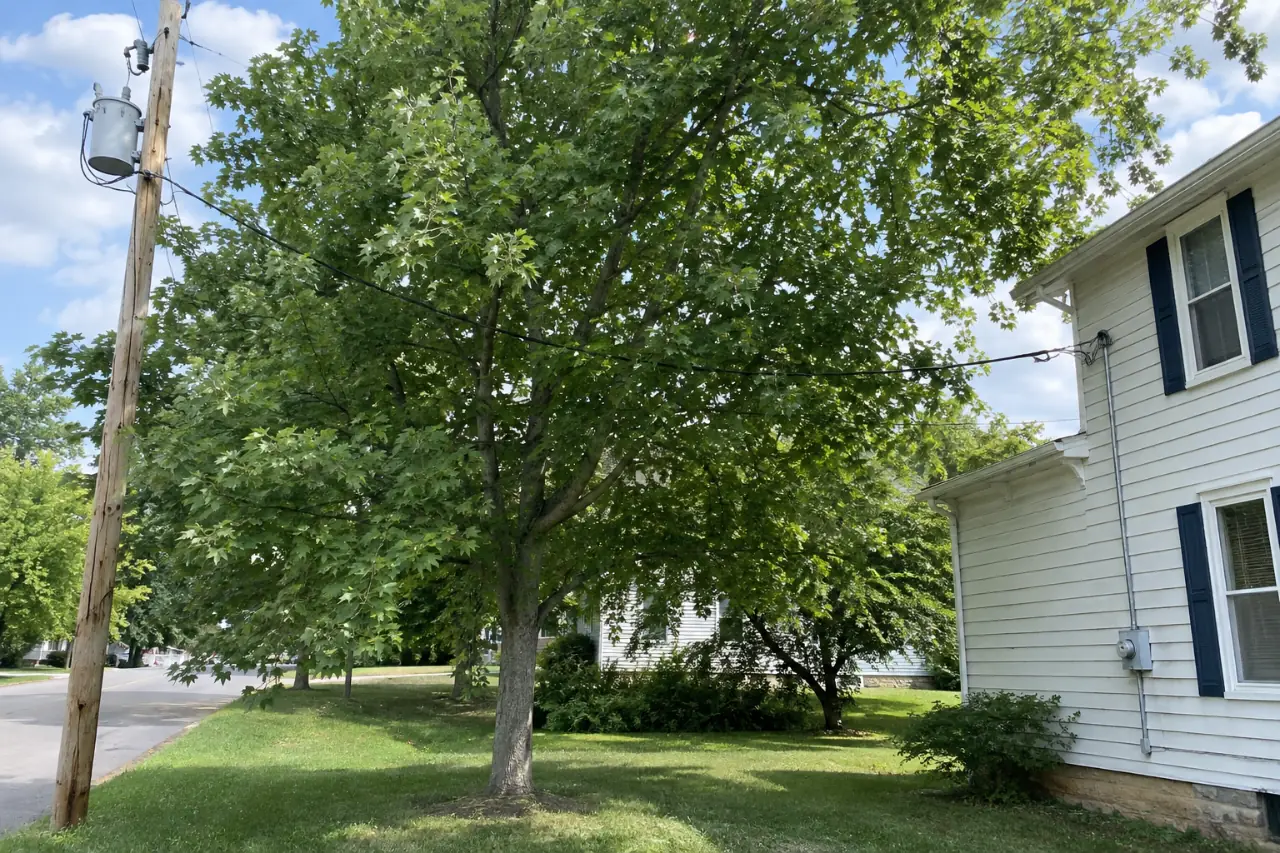
The single wire from the pole to the house, called the service drop, is the one homeowners ask about most. Neither the Town's Energy Services page nor REC's tree pages say who trims around it (checked Nov 22, 2026). Call your utility and ask, before anyone climbs.
What the law says is clear. If the job would bring a person or a tool within 10 feet of a line over 600 volts, the person responsible for the work notifies the line's owner on a working day, and the owner starts the agreed safety arrangements within five working days: a barrier, a temporary shutoff and grounding, or moving or raising the line (§59.1-410, checked Nov 22, 2026). The cost is paid by the person responsible for the work, but for residential property "such actual expenses shall be limited to those in excess of $1,000," and the line's owner has to give an estimate of scope and cost on request.
What does Virginia's ten-foot law require?
The Overhead High Voltage Line Safety Act (Va. Code §§59.1-406 to 59.1-414, checked Nov 22, 2026) says:
- What counts. High voltage means above-ground conductors, bare or insulated, carrying more than 600 volts, unless de-energized and grounded or enclosed in rigid conduit (§59.1-407).
- The rule. No one may perform or require work that puts any person or equipment within 10 feet of such a line until the danger has been guarded against (§59.1-408).
- The notice. It must say who's doing the work, where, what kind and how much, and the scheduled start and finish (§59.1-411). Utilities must publish a number for it.
- Who is exempt. The utility's own workers and contractors maintaining the lines (§59.1-413).
- The penalty. Enforced as a safety standard by the Commissioner of Labor and Industry; where that doesn't reach, a civil penalty of up to $1,000 (§59.1-412). Someone who violates the rule and causes damage must indemnify the line's owner (§59.1-414).
Downed lines are the sharpest version of this. During the June 29, 2012 derecho, the Weather Service logged an injury in Fairfax County when an 18-year-old was electrocuted by downed power lines (NWS Storm Data, June 2012). Treat any line on the ground or in a fallen tree as live.
What can you plant near lines and equipment?
The Town's planting notice asks residents to keep three feet of clearance on the sides and back of electric equipment such as transformers, six feet in front, to "avoid planting shrubs or setting posts directly over cables," and to call 811 before digging (Town notice, Royal Examiner, undated, checked Nov 22, 2026). REC's advice is simpler: plant "trees and shrubs away from power lines" to cut down on pruning (REC, checked Nov 22, 2026). A tree that will top out at 60 feet doesn't belong under a line that's 30 feet up.
When have trees knocked out power here?
- Jan. 17, 2023. About 1,100 homes and businesses on the south side of Front Royal lost power at 6 a.m.; Town crews restored service by 8:10 a.m. by switching load, and REC traced "a tree-related issue on their end" and restored the feed to the Town's substation at 11:22 a.m. (Town of Front Royal).
- February 2019. More than a half-inch of ice in Warren County; nearly 2,500 REC members out at the peak (REC).
- June 29, 2012. The derecho left numerous trees down near Front Royal and more than 4 million customers without power across its path (NWS Storm Data; NWS assessment).
A tree at your place?
One independent local contractor who works Front Royal and Warren County can come look at it and give you a price.
Call (540) 660-7988 Or describe it on the request form